
Asphalt Estimator
Asphalt is ordered by the ton, but you measure your driveway in feet. This estimator converts area and compacted thickness into cubic yards and tons of hot-mix asphalt, adds a waste allowance and, if you want, the crushed-stone base underneath — so you can check a contractor’s quote or order the right amount for a repair.
- Free to use
- No sign-up
- Runs in your browser
Asphalt estimator
Paving Project Planner Pack
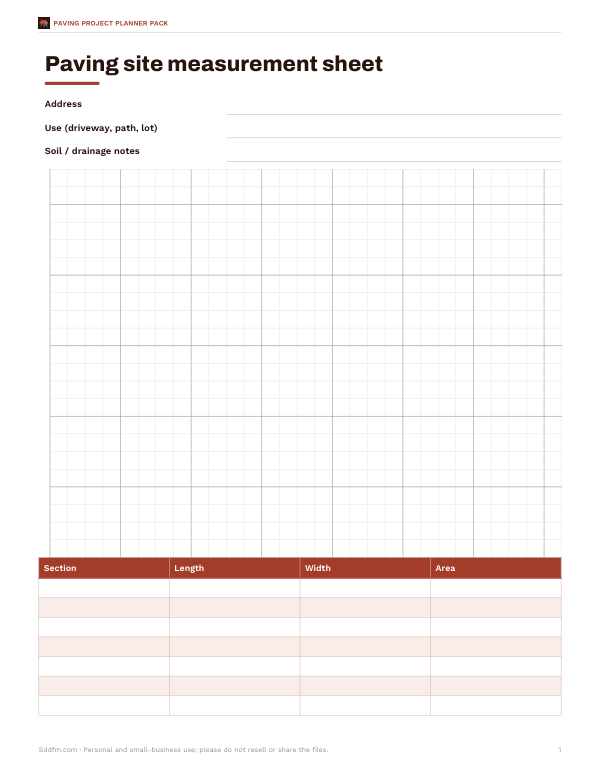
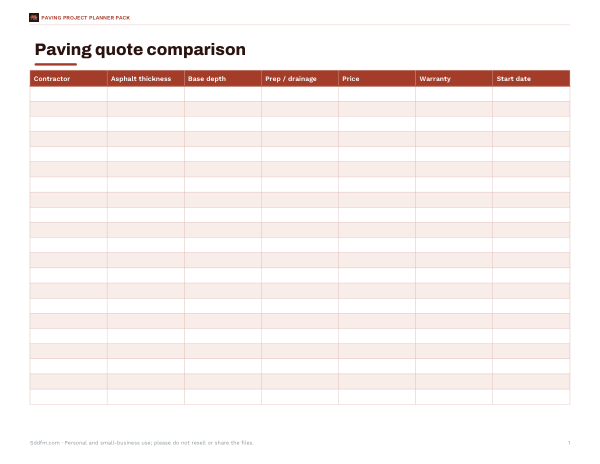
Printable paving planners: site measurement sheet with sketch grid, material estimate worksheet, contractor quote comparison and a driveway maintenance log.
- Site measurement (PDF)
- Estimate worksheet (XLSX)
- Quote comparison (PDF/DOCX/XLSX)
- Maintenance log (PDF/DOCX/XLSX)
Formats: PDF, XLSX, DOCX. Instant download after payment (link valid 72 hours, up to 5 downloads). AI-assisted: the templates were drafted with AI help and reviewed and laid out before publishing.
$3.00 USD, one-time 4 files · about $0.75 each
- Instant download
- 7-day refund
- Secure checkout by Stripe
7-day money-back guarantee. Full refund within 7 days of purchase, even after you download.
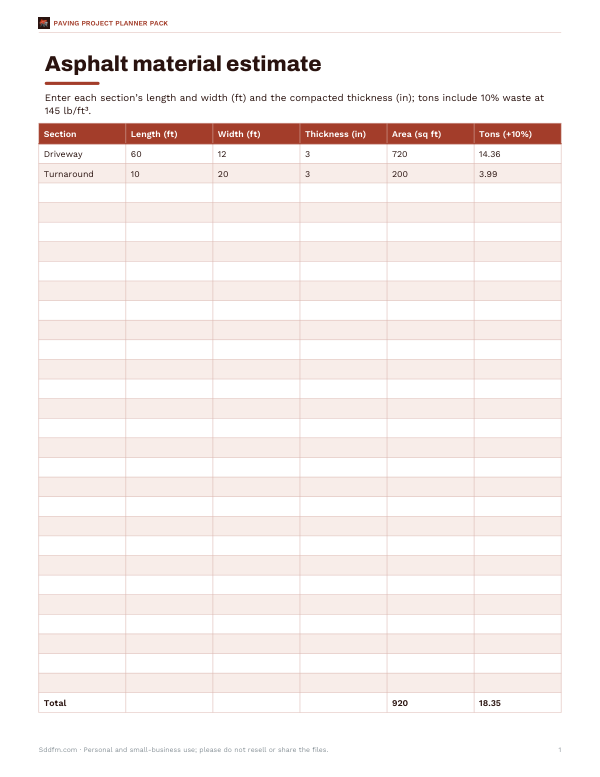
Free sample: Asphalt Material Estimate (PDF, 55 KB)
Full refund within 7 days — see the refund policy and license.
Free printables
Single sheets you can print right now, no sign-up. The full pack adds every sheet in one download plus the editable files.
 Printable Driveway Maintenance Log
The asphalt formula
- Area (sq ft) = length × width, summed for each section.
- Volume (cu ft) = area × compacted thickness (in) ÷ 12.
- Weight (lb) = volume × density — typically about 145 lb per cubic foot for compacted hot-mix asphalt.
- Tons = pounds ÷ 2,000 (US short tons), then add 5–10% for waste and edges.
A quick rule of thumb: at 145 lb/ft³, one inch of compacted asphalt weighs about 110 lb per square yard, so a 3-inch layer weighs about 330 lb per square yard. Metric users can use about 2.3 tonnes per cubic metre.
Typical thicknesses
| Use | Compacted asphalt | Gravel base |
|---|---|---|
| Footpaths and garden paths | 2 in (50 mm) | 4 in (100 mm) |
| Residential driveway | 2–3 in (50–75 mm) | 6–8 in (150–200 mm) |
| Driveway with heavy vehicles (RV, trucks) | 3–4 in (75–100 mm) | 8–12 in (200–300 mm) |
| Parking lots, light traffic | 3–4 in | 6–10 in |
| Overlay on existing asphalt | 1.5–2 in (40–50 mm) | None (existing surface) |
These are common ranges; local climate, soil and traffic change the right design. Weak or clay soils need a thicker base, and freezing climates need good drainage underneath. A local paving contractor or engineer can advise for your site.
Worked example: a driveway
A driveway is 60 × 12 ft with a 10 × 20 ft turnaround: 720 + 200 = 920 sq ft. At 3 inches compacted, the volume is 920 × 3 ÷ 12 = 230 cu ft, or 8.5 cu yd. At 145 lb/ft³ that is 33,350 lb — 16.7 tons — and with 10% waste about 18.3 tons, roughly one tri-axle truckload. A 6-inch crushed stone base adds about 460 cu ft, or around 28 tons. At, say, $120 per ton for asphalt and $35 per ton for base, materials alone come to about $3,200 before labour and equipment.
Patching and small repairs
- For potholes, clean out loose material, square up the edges and make sure the base is firm and dry.
- Cold-patch asphalt in bags is convenient for small holes; hot-mix lasts longer for bigger areas.
- Compact in layers of about 2 inches, overfilling slightly so it compacts flush.
- A 50 lb bag of cold patch fills roughly half a square foot at 2 inches deep — check the bag’s coverage.
Buying asphalt
Hot-mix asphalt comes from an asphalt plant and must be laid and compacted while hot, which is why most driveways are done by contractors with a paver and roller. Plants usually sell by the ton with a minimum order and may be closed in cold months. When comparing quotes, check the compacted thickness, the base depth and preparation, drainage and edge details, and whether sealing is included.
Asphalt vs other driveway surfaces
| Surface | Typical pros | Typical cons |
|---|---|---|
| Asphalt | Lower upfront cost than concrete, quick to lay, flexible in freeze–thaw climates | Needs sealing and crack repair; softens in extreme heat |
| Concrete | Long life, light colour stays cooler | Higher cost; cracks can be hard to repair invisibly |
| Gravel | Cheapest, drains well | Needs regular topping up and raking; can migrate |
| Pavers | Attractive, repairable piece by piece | Higher cost and labour |
| Recycled asphalt (millings) | Low cost, firmer than gravel | Rougher finish; performance varies |
Costs and suitability vary widely by region and climate; get local quotes before deciding.
Why the base matters
Most asphalt failures start underneath. A well-compacted crushed-stone base spreads loads, lets water drain and gives the asphalt a firm, even platform. On soft or clay soils, contractors may remove more soil, add a thicker base or use a geotextile fabric. Good drainage — a slight crown or slope so water runs off the edges — is just as important as thickness. When a quote seems unusually cheap, ask how much excavation and base work is included.
Measuring an irregular driveway
Break the area into rectangles and circles, enter each on its own line and add them up — the estimator does this for you. For curves, measure the average width at several points along the length. For a tapered section, use the average of the two end widths. Add a little for flared entrances where the driveway meets the road. Accurate measurements matter: at 3 inches thick, every extra 100 square feet adds about 1.8 tons of asphalt.
Maintenance
- Keep new asphalt free of heavy loads and sharp turning for the first days while it cures.
- Seal cracks promptly to keep water out of the base.
- Many owners seal-coat every few years to protect the surface from oxidation.
- Ensure water drains away from the edges.
Privacy
The estimator runs in your browser; nothing is uploaded.
Frequently asked questions
How many tons of asphalt do I need?
Area (sq ft) × thickness (in) ÷ 12 × 145 ÷ 2,000, plus about 10% waste.
How much does a ton of asphalt cover?
At 3 inches compacted, about 55 sq ft (6 sq yd); at 2 inches, about 83 sq ft.
How thick should a driveway be?
Typically 2–3 inches of compacted asphalt over 6–8 inches of gravel base.
What does asphalt weigh?
About 145 lb per cubic foot compacted, or 2.3 tonnes per cubic metre.
How many tons in a truckload?
A tri-axle dump truck often carries around 20 tons; smaller trucks carry less.
Does this include labour?
No — it estimates materials only.
How long before I can drive on new asphalt?
Contractors often advise waiting a few days for cars and longer for heavy vehicles, especially in hot weather.